Sunday, September 2, 2007

Xinjiang food


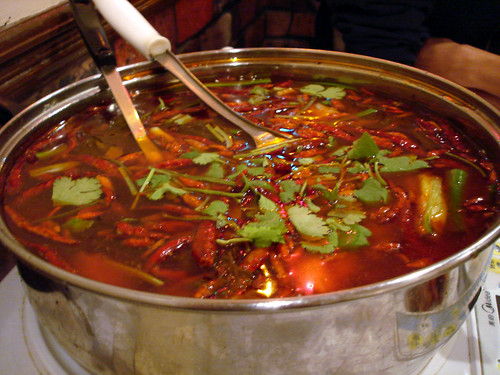
I recently had dinner with some friends at a Xinjiang restaurant in Shanghai. The Xinjiang Uygur Autonomous Region is in northwest China and borders Kazakhstan and Pakistan. It is heavily Muslim, which is reflected in the cuisine - lots of lamb. While the roast lamb leg we ordered was excellent, the lack of any real vegetables on the menu (as well as the intense flavor of dish after dish of lamb) will probably keep me from going back for more. However, it was really impressive to see the wide cultural range of a country as homogeneous as China.

By the way, the picture above was not taken by me during our dinner. I've borrowed a picture from Flickr that looks like the meal we had.

Air China is not much better

Check out this conversation between an Air China pilot and the control tower at JFK. Now, the average United pilot would probably be much worse at Chinese, but somehow it seems unsafe to have someone who can't speak English communicating about basic safety issues. Even I can barely figure out what he is saying -- and I have a good bit of practice when it comes to understanding Chinese-accented English.

Do not fly China Airlines - ever


On my trips to Taiwan, I almost always flew Cathay Pacific, which is based in Hong Kong and is a OneWorld Alliance member. When that was not available, I would fly Eva Air, a Taiwan carrier. I never flew China Airlines, the flagship carrier of Taiwan (the whole political naming issue often gets China Airlines confused with Air China).

Why? China Airlines has a terrible safety record. A long history of pilot error and poor maintenance makes it one of the more dangerous major air carriers. An explosion in Okinawa a few weeks ago is just another blemish on its record. Just after pulling in to the gate area, the plane exploded in a ball of fire.

Not wanting to further damage the reputation of the airline, China Airlines proceeded to paint over the logo on the plane as it awaited cleanup. I guess they didn't want ignorant passengers who hadn't heard of the story to see the plane in person?

Wednesday, August 29, 2007

Blue skies in Shanghai


Just in time for my previous post about pollution in China, the weather gods in Shanghai have provided nearly a week of clear skies. I think it all started when a typhoon blew away much of the cloud cover and pollution a few weeks ago, but I'm also told September in Shanghai typically brings out the blue skies.

Tuesday, August 28, 2007

New York Times on China pollution

In case you missed it, the New York Times is running a series on the growing pollution problem in China. I highly recommend you read it. Pollution in China is a huge problem for a multitude of reasons that cannot be easily solved. Foreigners like to point out China's addiction to coal and the inefficiency of its factories. In addition, China could do a lot more to boost conservation and energy efficiency (something as simple as mandating insulation and double paned windows in buildings would help).

Chinese air travel is not fun


I've posted before about the joys of Chinese air travel. But that was as a tourist. It's even worse for a corporate traveler. The concept of free upgrades for elite frequent fliers is not really prevalent in Asia. The Chinese airports (except Hong Kong) also aren't businessman-friendly. WiFi (paid or otherwise) is shockingly absent and there are no power outlets. Here's a picture of one I found in Shanghai Pudong airport by sneaking around a store and moving a garbage can out of the way.

Monday, August 27, 2007

Sichuan, China


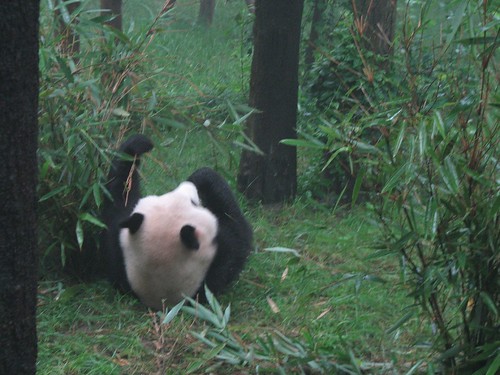
I had the chance recently to go to visit Chengdu, which is located in Sichuan province. Few Americans have likely heard of Chengdu, but it is a major metropolis in China. It was the first imperial capital of China, and remains a cultural, political, economic and most importantly culinary center. It’s other claim to fame is that it is home to the Chinese Panda Research Base, since it is in the heart of the panda’s shrinking geographic range.

My trip to the area was short (less than 30 hours), but fun. The first thing I noticed was that it there are no Caucasian people. Well, that’s an overstatement. I saw one German father with his half-chinese kids in the hotel, but that’s it. Chengdu isn’t on most tour group itineraries, and the backpackers in Chengdu heading towards Tibet aren’t hanging out on the street in large enough crowds to be noticed.

If you want to see pandas, there are two places to go.

- Chengdu Panda Research Base: This is just on the outskirts of the city. It’ll take about 20-40 minutes to get there depending on where in the city you are and the traffic. They house about 30 pandas here for breeding and research (but mostly breeding.)

- Wolong Panda Reserve: About 3 hours away from Chengdu, this is more of a conservational effort, housing 150 pandas. They keep the pandas in a more natural environment while studying the animals.


Even though I had arrived in the middle of the night (2 AM) in Chengdu, I got up the next morning at 7 AM to visit the Panda Research Base. Pandas pretty much just eat and sleep, so you have to get to the research center before 10 AM while the animals are still eating. Otherwise, you’ll be lucky to see a panda just sleeping. If you’re unlucky, you’ll see bamboo, behind which a panda is sleeping. I arrived with my coworker at 8 AM, so it was pretty cool. Not the most impressive facility in the world, but amazing to see so many pandas just a few feet away. In most zoos, the two pandas on display are behind high fences and are the prized possession. Here, there are pandas everywhere you turn. On certain days, you can actually pay 400 RMB to get your picture taken petting a panda. Unfortunately, I did not go on such a day.


The other good thing about Chengdu is the food. In the United States, Sichuan food is spicy. If you’ve gone to a Chinese restaurant that has a menu with peppers next to the menu item indicating its spiciness, it’s probably a Sichuan restaurant. But the problem is that until recently, the key ingredient in the food, the Sichuan peppercorn, was banned in the US due to potential bacterial contamination that would harm citrus crops. It has since been lifted as long as the peppercorns are heated to a temperature that can kill the bacteria. Now, most people know I can’t eat a lot of hot foods, but I’ve come to really enjoy Sichuan food. The use of regular chili peppers and Sichuan peppercorns creates a flavor/sensation the Chinese call “mala” or numb and spicy. The peppers add the heat, but a chemical in the peppercorns numb your tongue, removing the heat and pain but allowing you to still taste everything. It’s great. I’m going to bring a kilo of the stuff back with me to the US so I can learn to cook it myself. Fortunately, Sichuan food is popular all across China as well, so if you’re in Beijing, Shanghai, or even Chicago, you can probably find a place that will deliver a decent experience.